
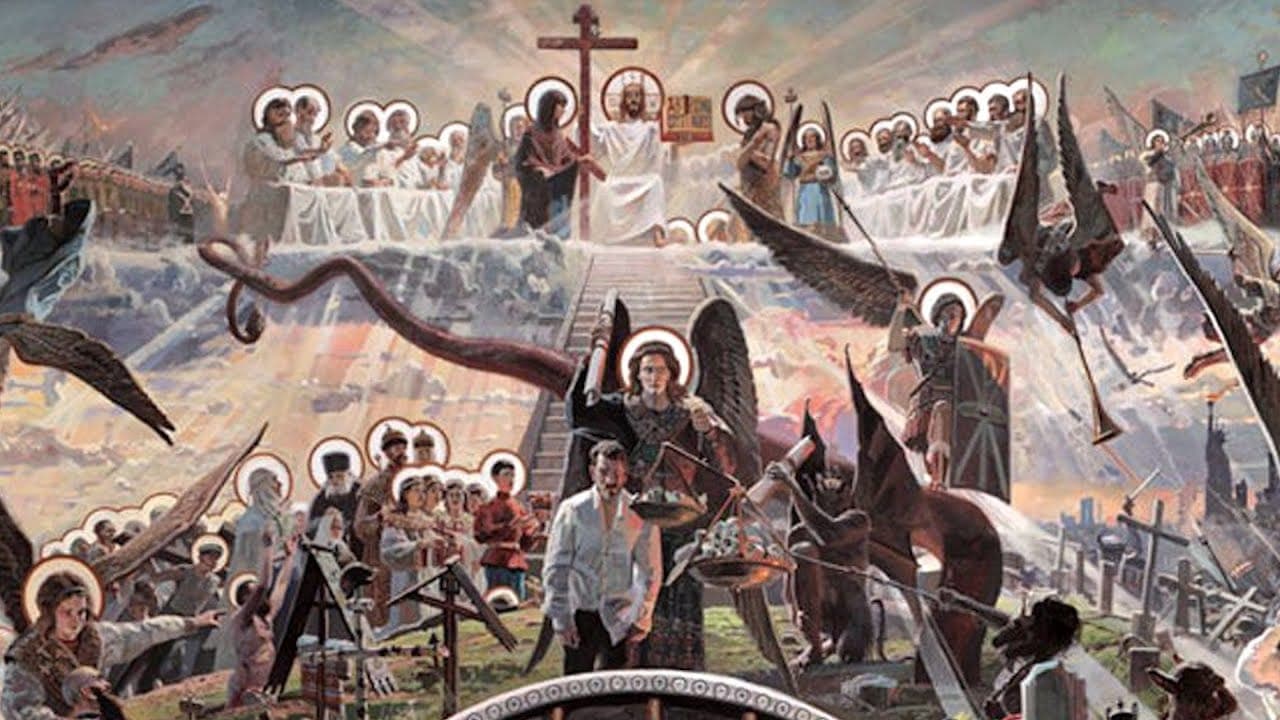
On the Eve of the Last Judgment
ACADEMY OF DEVELOPMENT MANAGEMENT – INSTITUTE OF SKY POLITICS
The European choice of "our Sacred Power" is clearly traceable in the monument "Millennium of Russia" erected in Veliky Novgorod in 1862, executed in the historiography of the Russian Empire of the Holstein-Gottorp-Romanov dynasty.
Most vividly, the European choice is indicated by the figures placed on the monument of Daniel of Galicia, Ivan III and Petro Mohyla. Whereas the first Russian tsar – the heir of the Horde – Ivan IV the Terrible is not on the monument.
The Grand Prince of Kiev Daniel of Galicia was crowned in 1253 by Pope Innocent IV as the first King of Rus’. He is depicted with the symbol of power, the scepter of the kingdom that never came to be.

The Grand Prince of Vladimir and Moscow Ivan III is presented as the sole-ruling sovereign of all Rus’ (1494) – in the Cap of Monomakh, with the orb and scepter in his hands. He established the ideology of the power of Rus’ from Byzantium.

Petro Mohyla (1596-1647), Metropolitan of Kiev, Galicia and all Rus’. Founder of the Kyiv-Mohyla Academy. An enlightener in dogmatic unanimity with Rome. The inspirer of the Russian church schism.

With the ideology of power from Byzantium, adopted by Ivan III, is connected the transformation of the legend of the origin of the title Russian tsar.
In biblical history, the governance of the Jewish people before the request to the Almighty for the granting of a king was spiritual and was carried out through judges and teachers of the Torah.
In response to the requests to the judges, God Himself chose as the first king of the people of Israel a humble man whose name was Saul.
The term "tsar" comes from the Hebrew (Assyrian) word SAR (s\ts) leader. And the ritual of enthronement provides for election to the kingdom from the people and anointing to the kingdom from the Almighty.
In Rus’, since the times of the Horde, the khan and representatives of the golden line of the Chinggisids were called tsar and tsareviches (apparently, after the people known from Scripture, the order of election of the khan, as with the biblical kings).
Ivan III was not a tsar. He was neither crowned nor wedded to the kingdom. But he fell under the flattery of the Vatican, which sent him as a wife the niece of the last Byzantine emperor, Sophia Palaiologina. And under the cunning of the Judaizers – Metropolitan of Moscow and all Rus’ Zosima – who was the first to put forward the idea of Moscow as the Third Rome.
Thus, together with the ideology of power from the Second Rome (Byzantium), Ivan III for the first time in Rus’ also received the title of sole-ruling Sovereign, and moreover not by the will of people, not by conquest or inheritance, but "by the grace of God".
Recognized as sovereign of the Russian land, but having at the same time fulfilled the design of the Vatican, Ivan III tore Rus’ away from its Asian selfhood (we Scythians) and attached it to Rome.
This was done in order to give pre-schism Orthodoxy from the Apostle Andrew a vaccination of Paulianity: the ideology from the Apostle Paul! The essence of Byzantine (the cunning Greeks) hypocrisy and the servility of the priesthood before the power of the emperor.
Here is what Leo Tolstoy wrote about Paulianity in 1907: "Paul – a Pharisee – headed a new religion, at the foundation of which he placed the very indefinite and unclear concepts that he had about the teaching of Christ. The Gospels say that people are equal, but Paul divides people into slaves and masters; Jesus abolishes taxes, Paul legalizes them; where Christ has forgiveness, Paul has a curse. Paul's religion is based on fear of punishment; a person must adhere to good intentions only in order to avoid retribution and receive a reward after death.
With the adoption of Byzantinism, there also occurred a substitution in the origin of the title of the Russian tsar, from the biblical to the Roman. Now it comes from the name Caesar – Caesar "emperor." The double-headed eagle was also adopted from Rome.
The first tsar of all Rus’ to pass through all three biblical stages of ascension to the throne: election to the tsardom, anointment to the tsardom, and crowning to the tsardom in 1547, was the heir of the Horde, Ivan IV. The tsar, by the method of eastern despotism, tried to overcome the Byzantine separation (symphony) of powers into the boyar zemstvo, the priesthood, and the tsardom by means of the oprichnina, but did not succeed.
The canvas of Russia's European choice, however, is built into the following chain of interconnected events.
In the Bible, the Jews asked the judges and the Almighty for a king for themselves.
The Vatican corrected the Hebrew "king" to the Latin – caesar (kesar). And wrote a legend to fit the history of Rus’ kinship with the emperors of Rome through Sophia Palaiologina, sent as a wife to Ivan III.
Then, through the elder Philotheus, the pro-Western doctrine of "Moscow – the Third Rome" was entrenched in the ideology of Russia's power.
Then the Ukrainian hierarchs in Moscow's service (ideas from the Kyiv-Mohyla Academy) brought matters to the Russian schism.
The Nikonians, having rejected pre-schism Orthodoxy, adopted Paulinism from Rome, and began to persecute the Old Believer schismatics.
With the doctrine of pre-schism Orthodoxy, the Russian church was open to the Will of Heaven.
With the adoption of Byzantinism, the Russian church, like Rome, became triumphant on earth.
Peter I the Great, a Westernizer, took the bait of Freemasonry with its idea of brotherly worldwide unity. Organizing the most drunken, most jesting assemblies, he mocked the priesthood. Finally he replaced the patriarch with a Synod headed by a civil chief procurator.
And the Synod was the first to betray the tsar in 1917. Nicholas II offered himself as head of the church, but the hierarchs refused him.
Already under the Bolsheviks, the patriarchate was revived in the Russian church. The capital returned to Moscow. The state flag again became red, as on pre-schism icons.
The Bolsheviks decided to renew Orthodoxy and put faith in the service of the working people. In Russian Marxism, God-seekers appeared. And in Orthodoxy, the Renovationists arose.
The head of the Renovationists, Metropolitan Vvedensky, debated with the People's Commissar of Education Lunacharsky at the Polytechnic Museum. The Renovationists were successful and took away two-thirds of the parishes from Patriarch Tikhon.
But the atheists in Bolshevism overcame the Russian God-seekers. The chief godless one, Emelyan Yaroslavsky (Minei Gubelman), brought matters in Russian Orthodoxy to complete discord.
The émigré church took upon itself the heritage of the apostolic church.
The Old Believers, as they had sat in the "revolutionary underground," remained there.
The locum tenens of the patriarch, after Tikhon's death, Metropolitan Peter, was packed off by the godless to the north, where he died, leaving behind a catacomb Orthodox church. Today it is headed by Metropolitan of All Rus’ Raphael. They have acquired a wonder-working icon, "The Mother of God, Resurrecting Rus’."
What remained of the ROC was recreated by Stalin in 1943, summoning four surviving bishops and releasing priests from the camps.
The question of true Orthodoxy rests on the continuity of the line of ordination of bishops (overseers: epi-over, skop-to look) from the apostles and fidelity to the apostolic dogmas.
The Vatican traces its line from Peter with the dogma of the duality "filioque."
The Russian triune Old Believer schismatics – from Andrew.
The Synodal ROC dominant after the schism – from Paul (he was not a disciple of Christ. He was not present at the Last Supper. The Holy Spirit did not descend upon him on the day of Pentecost).
The Paulinists blessed the existing Russian government and all its deeds. The well-informed renegade and émigré theologian Deacon Kuraev told about this in great detail.

Moscow, the "last trench of Orthodoxy" – the Third Eastern Rome under the leadership of His Holiness our Moscow Patriarch Kirill – has managed to drive away and lose all the sister churches that were on the territory of the Russian Empire and the USSR.
All the Baltics and the Orthodox dioceses of Finland have gone over from the Moscow Patriarchate to the Greek Ecumenical Patriarch, His All-Holiness Bartholomew.
Moldova – has left. Georgia – has left.
And the doctrine of "Moscow – the Third Rome" was finally buried by the Special Military Operation in the Ukrainian theater of operations, which tore apart the sacred connection between Moscow and Ukraine.
Thus in the "trench of Eastern Rome," on the eve of the Last Judgment, no one remained except the Moscow Patriarchate...
Performed by Andrey Devyatov No1012 of 18.03.25
Comments 31
Sign in to leave a comment.
Sign inСергей
А.П. Девятов: "Так в "окопе Рима Восточного" в преддверии Страшного Суда никого кроме Московского Патриархата не осталось..." преп. Лаврентий Чернинговский: «Как нельзя разделить Пресвятую Троицу, Отца и Сына и Святого Духа, это Един Бог, так нельзя разделить Россию, Украину и Белоруссию. Это вместе Святая Русь.…
Original · translation not yet available
Анонимный участник devyatov.su
Понимаю, Гром, неприятно тебе: обесценили работу и ты сел в лужу с ссылкой. Бывает! Полагаю, что вопрос о занятии по ДУШЕ (ключевое слово - прим.) можно действительно закрывать. М-да, не доходят до тебя такие материи. )) Извини, что переоценил тебя. Бывай!
Original · translation not yet available
Анонимный участник devyatov.su
Гром так и не увидел ответа на свой вопрос. А с чего франт Кирюха решил что на его дурацкий и глупый вопрос ("цепляет"?) кто-то станет отвечать? Да и после того, как Гром дал ссылку на ВК страничку, а Кирилл её "стыливо/ссыкливо" удалил, нет большого смысла в "общении".
Original · translation not yet available
Александр
Тайское венчание на царство (фотографии есть) - это современный пример того,что было по всей Азии.
Original · translation not yet available
Александр
Всем рекомендую в интернете посмотреть или почитать церемонии венчания на царство брахманами короля Тайланда. Полагаю, много общего с венчанием на царство первых Царей Израиля. У брахманов тоже помазание. Полагаю, это та церемония, что была по всей Азии эпохи "Осевого времени" (под влиянием Единой Степи - от бедуинов…
Original · translation not yet available
Анонимный участник devyatov.su
Воюй, жертва ЕГЭ, только не под моими комментариями. Не путайся под ногами, Шарик(ова), дай дорогу здравомыслию других людей! Уже давно не читаю твои безграмотные тирады. Не забывай о самолюбовании. ))) Своевременно ставь лайк в конце своего "гениального" левачного высера! ))) Образование, видимо, пошло совершенно…
Original · translation not yet available
Анонимный участник devyatov.su
И, как всегда, Гром растёкся по обширному древу своей демагогии. )) Тогда спрошу прямо: искусство тебя "цепляет" или нет? Хочешь, перечислю ещё несколько российских музеев, где можно лицезреть русские картины? Пальцев на руке у тебя явно не хватит! Если опять не угодил, то скажу по-другому. Сравни живопись т.н.…
Original · translation not yet available
Анонимный участник devyatov.su
И где ты вычитал страшные сказки про отрезанные у водолазов уши? Я фигею от твоего маразма, верить буржуйским сказкам могут только идиоты!! Кому выгодно вопрос задавай баран!! ОбОЛГАТЬ СССР ВЫГОДНО БУРЖУЯМ, чем и занимались с 80 х годов!! Ты ночью не ссышь в постель от страха? Вредно читать страшные сказки малыш!!и…
Original · translation not yet available
Анонимный участник devyatov.su
Гром не собирается дискутировать с Фрателло по СУБЪЕКТИВНЫМ (оценочным: я художник, я так это вижу:)) вопросам искусств (живописи, мозаики, техниках "художественной мазни") или технике ручного "ковыряния металла" штемпельных пар медальерами ПРОШЛЫХ веков. Грома во всех искусствах всегда и в первую очередь интересовало…
Original · translation not yet available
Анонимный участник devyatov.su
Пётр Адольфович, а помните, как в СССР бездушно действовали власти? Отрезали уши иностранным военным водолазам для разумения, которые планировали осуществлять диверсии на советских кораблях ВМФ накануне "Олимпиады-80". )) Куда же вы дели медаль на мундире "За 70-летие Вооружённых Сил СССР"?
Original · translation not yet available
Анонимный участник devyatov.su
Гром, выражаясь языком одного киногероя, скажу, что одному нравится арбуз, а другому - свиной хрящик. Чтобы с тобой дискутировать, ты должен, по крайней мере, разбираться в базовых понятиях изобразительного искусства/живописи, техники письма или ручной резки штемпельной пары медальером. Полагаю, было бы жалкое…
Original · translation not yet available
Анонимный участник devyatov.su
Ирина: "Дело не в Софье . Запад притягивает развитием, более высоким уровнем жизни. В этом дело. Ведь не боролись с низкопоклонством перед Африкой). Человек ищет, где лучше, а рыба где глубже. И побороть пропагандой выбор сердца невозможно." ================= О развитии. В частности, о пище и питании. Взять, к…
Original · translation not yet available
Андрей Петрович Девятов
Рим, что Первый, что Второй, что Третий - это БЕЗДУШНАЯ ГОСУДАРСТВЕННАЯ ТИРАНИЯ
Original · translation not yet available
Анонимный участник devyatov.su
Грому до радостей ли... или до горестей Фрателло как-то "фиолетово" - от них ни холодно ни жарко - в общем НИКАК )) У дедушки Крылова - БАСНИ... и Гром их приводит в полном объёме (включая цензурные изъятия), а никак не выдержками. Выдержки - это "у вас": крепкие не очень... выдержанные или молодые…
Original · translation not yet available
Анонимный участник devyatov.su
"Течёт вода Кубань-реки куда велят большевики!" Куда БОЛЬШЕВИКИ повелят, туда и потечёт и музыка, и игры, и фильмы.
Original · translation not yet available
Анонимный участник devyatov.su
Браво Гром! Мочите эту шавку буржуйскую!! Удачи вам и здоровья!!
Original · translation not yet available
Сергей
Толстой, может быть, и великий писатель, но плохой богослов. Поэтому считать, что граф прав в отношении своего толкования христианства, это заблуждение. Почитание св. апостолов Петра и Павла и празднование установленного в их честь дня ведется задолго до того, как Софья Палеолог приехала на Русь. И празднуется не…
Original · translation not yet available
Ирина_Brenta
Сколько людей прочитало Ильина/Дугина? И кто с ним согласен?. Какой процент молодежи ходит в церковь, читает Библию? Можно считать ноль. А некоторые культовые голливудские фильмы знает наизусть большая часть населения. Слушает западую музыку, играет в компьютерные игры, смотрят аниме. Вроде пропаганда по ТВ не…
Original · translation not yet available
Анонимный участник devyatov.su
Напрасно, Пётр Адольфович, вы утверждаете, что И.Сталина отравили. Эту бездоказательную "пулю" запустил Е.Спицын. Сослался он на какой-то конфиденциальный разговор за рюмкой чая с неким представителем спецслужб, который якобы видел какие-то закрытые документы. Именно так рождаются слухи в сети. Серьёзные историки…
Original · translation not yet available
Андрей Петрович Девятов
Вопрос истока власти на Руси с опорой на Софью Палеолог павлианцы истолковали аж от Августа Октавиана - первого императора Рима. Отсюда пошло-поехало. и доехало до Ивана Ильина, Дугина, Птина: "Мы с Вами одной крови, господин Шваб. Не сомневайтесь. Мы не подведем." А евразийцы (Н. Трубецкой) четко обосновали истое…
Original · translation not yet available
20 of 31 loaded